
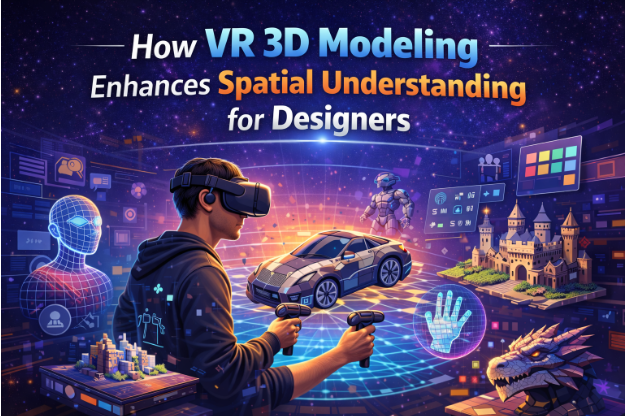
For designers, imagination has been applied to spatial perception. Some help but still leave so many gaps between what is designed and what is experienced: flat screens, blueprints, and rotating models. Here comes VR 3D modeling to the rescue.
Rather than estimating the proportions or scale, designers will step into the work and see it from the perspective of the user. For a design company, VR started becoming an important tool for sharpening spatial thinking at all stages, instead of just being a novelty when working with a 3D visualization company.
Experiencing Scale Instead of Estimating It
Scale is one of the most difficult topics in design. When something looks perfect on a monitor, it could either be tiny and cramped or large and overwhelming in real life. This is where VR 3D modeling bridges the gap.
Designers could walk through rooms, stand next to objects, and immediately feel whether the scale is right or not. Such experiential learning will offer greater accuracy to spatial decisions and reduce later corrections.
Understanding Depth and Proportion More Naturally
Depth is hard to judge on a flat screen, irrespective of how sophisticated the software is. In the VR mode, designers have natural depth perception and can relate how elements work with each other in three-dimensional space.
All of a sudden, relative distances in terms of placement between objects, overall ceiling heights, or where the focal points are become oh-so-obvious. That clarity is exceedingly important in helping designers judge their proportions early rather than becoming aware of issues later during production.
Seeing Design From the User’s Point of View
Designs do not exist for designers. They exist for the user. VR allows teams to experience spaces in the same way an end user would.
From navigating within a virtual environment, traversing spaces, to actually interacting with the elements, designers begin to appreciate the way individuals will ultimately perceive the design. This leads to improvements in layouts, intuitive wayfinding, and spatial flow.
Reducing Misinterpretation Between Teams
Confused mediums of space arise while drawings are passed from one department to another. What may be intuitive to one may just as easily confound the other. VR 3D modeling provides a common reference axis.
If something is real-space, then the whole team sees it the same way. These bona fide knowledge augmentations reduce the need to go back and forth among conceptual stages for every team working alongside a 3D visualization company.
Identifying Design Flaws Earlier
These little spatial issues can develop into major problems if they happen to escape the eye. Enter VR, which brings these issues to light really early. Squeezed hallways, awkward sightlines, or elements that appear to be wrongly placed become rather prominent while inside the model. Noting and addressing such issues before they go into development or construction will save time, money, and headaches. Designers can then alter layouts, secure in their knowledge that the changes will actually enhance the experience.
Improving Creative Confidence
When designers comprehend a space, they exercise their decisions with confidence. Exactly, this is where VR changes the equation. No more guessing whether something will work or not; Instead, a designer can very quickly test it there and then.
This makes room for bolder choices, better experimentation, and even stronger results. Creative ideas suddenly appear less risky when they can be explored in real time while actually being modified as one sees fit.
Making Feedback More Clear and Actionable
Feedback often sounds vague as it is based on imagination rather than on experience. VR breaks that chain. Stakeholders can walk through the design and give input that is concrete and can be put into practice.
The comments morph from “this feels weird” to “this feels too narrow over here” or “this element blocks my view.” That clarity helps designers to implement changes precisely instead of guessing the proper fixes.
Conclusion
The spatial knowledge grows tremendously when a designer steps into their own making. VR 3D modeling changes the scale, depth, and flow from abstract measurements to real sensations.
For designers working alongside a 3D visualization company, fewer assumptions, better conclusions, and intuitive designs have simply been brought into this chapter by VR. It does not substitute design skills; it enhances them with VR in a way that space will be experienced by you, not only imagined by you.